Project
ATLAS
A sovereign local AI assistant, deployed inside my oncology clinic. It helps me in my daily work as a physician and as a director.
Everything runs on a server installed at our place. Nothing leaves the center.
Why
In a medical clinic, patient data cannot leave for the cloud. Consumer AI assistants, on the other hand, don't speak medicine. We end up oscillating between the two: either we lose time, or we take risks.
ATLAS is built to fill that gap. An assistant that understands our work, runs at our place, and never leaves the center.
What it does
I am a physician, and I also direct a clinic. Two hats, with a real degree for the first and nothing for the second. ATLAS helps me on both fronts.
Physician side
- Automatic consultation report generation.
- Medical voice dictation (speech-to-text).
- OCR of patient documents (PDFs, scans, letters).
- Smart search inside patient files (RAG).
Director side
- Reports from partner meetings.
- Cash flow tracking and analysis.
- Operational improvement paths.
- Everything stays local, so no risk of exposing sensitive clinic data.
What it does not do
ATLAS is not a clinical decision tool. No tumor segmentation, no therapeutic suggestion, no diagnosis. Medical decisions remain entirely with the physician.
The day those uses are explored, it will be with a validation framework and the right team. Not before.
Hardware and sovereignty
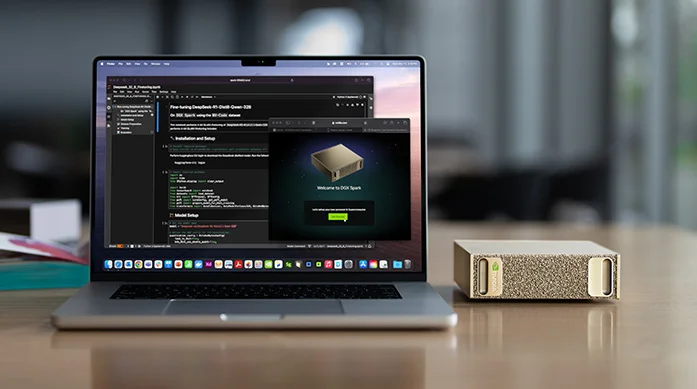
- NVIDIA DGX Spark server installed inside the clinic. 128 GB of unified memory, Blackwell architecture.
- No data leaves the clinic: no cloud, no external API.
- AI impact assessment framework, compliant with French data protection authority (CNIL).
My team
- Gregory Messador: IT.
- Mario Pazzola: medical physicist.
A great team.
For whom
For everyone in the clinic: physicians, physicists, technologists, secretaries, management. ATLAS aims to offer a global assistant.
Because if every one of these roles is amplified by AI, it ultimately reaches the patient. A real global care experience, not just a part of the journey.
Frequently asked questions
What is ATLAS?
ATLAS is a sovereign AI assistant deployed locally in a private 50-person radiation therapy center. It runs on an NVIDIA DGX Spark server the size of a shoebox. No patient data ever leaves the clinic.
Does ATLAS make medical decisions?
No. ATLAS does not diagnose, suggest treatments, or perform segmentation. Its role is to return time to care by handling bureaucracy: generating consultation reports, dictation, OCR, search across patient records.
Why on-premise AI instead of cloud?
Patient data sovereignty. Strict GDPR compliance. Zero risk of exposure outside the clinic. Models run entirely on local hardware, without any external API call.
Who leads the project?
Julien Welmant (radiation oncologist, co-director of ONCODOC), Grégory Messador (CTO of Oncodoc) and Mario Pazzola (medical physicist). Internal team, build in public on LinkedIn and X.