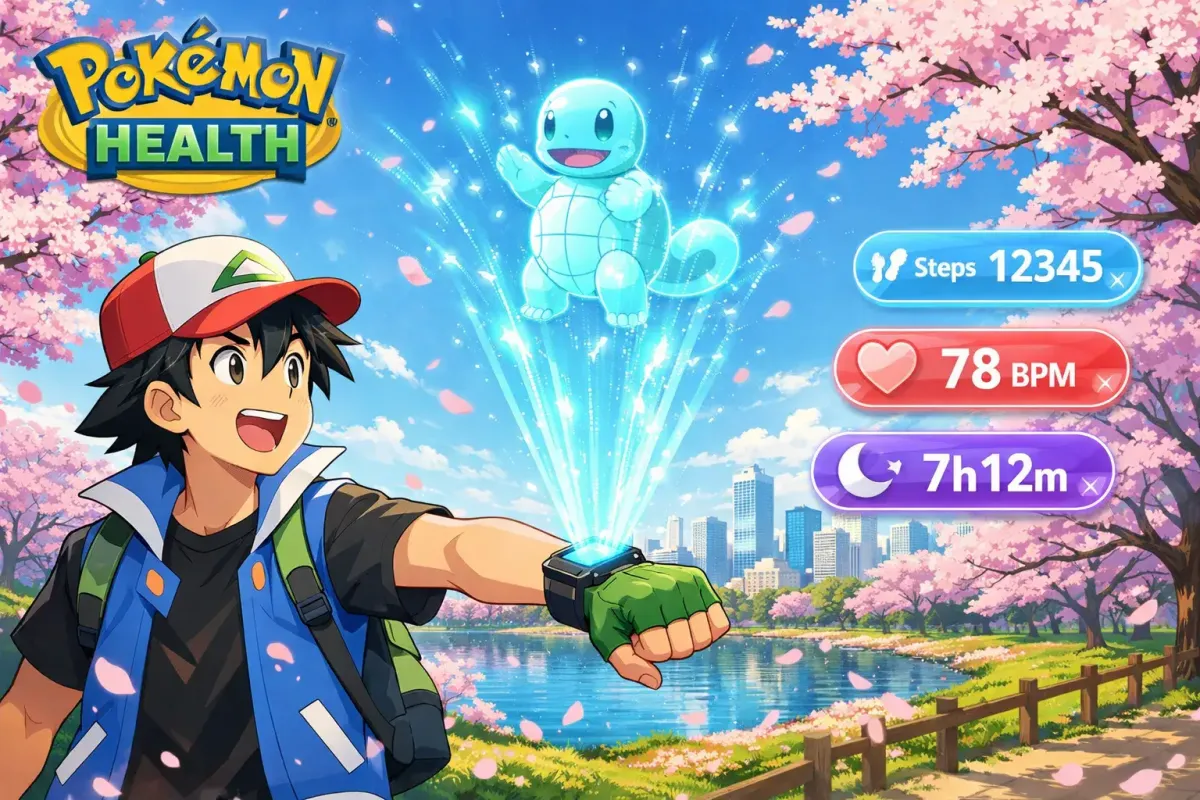
What if your wearable projected your Pokemon? Concept art.
TL;DR
Pokemon is built on care, evolution and companionship. Its core mechanics mirror exactly what preventive health needs: daily engagement, emotional attachment, visible progress. The science backs it up. Here’s how it could work.
What if Pokemon got into healthcare?
Imagine. You go for a morning run. Your Eevee runs alongside you on your watch screen. You speed up, it speeds up. You stop, it looks at you, a little disappointed. You start again. It smiles.
Imagine a Snorlax that sulks when you don’t sleep enough. A Growlithe that gets excited when you chain three days of exercise. A Chansey that reminds you to drink water by handing you an Oran Berry.
Imagine a world where the Pokemon Center is your local hospital. Where Nurse Joy greets you with a smile. Where a child scared of their radiation session opens the app and sees their Riolu waiting for them in the treatment room.
What if your doctor prescribed you a Pokemon?
It doesn’t exist yet. But everything is in place for it to work.
Pokemon reaches ages 5 to 50. One billion fans. Thirty years of emotional attachment. The franchise got millions of people walking outside with Pokemon GO without ever telling them “it’s good for your health.” It did it by making every step fun.
Here’s what I’ve imagined. Two levels, from daily wellness to nutrition. And here’s why it would work, evidence included.
Pokemon carries thirty years of emotional life across several generations. It’s not just another franchise. It’s a living myth that billions of people pass down to each other. With Pokemon GO, the franchise already showed it could get millions of people walking outside, and bring them back to public space. It proved that its emotional infrastructure can meet the real world. Pokemon Health is the natural next move.
Pokemon already speaks the language of care
Most health apps fail because they treat humans like machines. Count your steps. Log your calories. Hit your target. Repeat. The engagement curve is always the same: a spike, a plateau, a cliff.
Pokemon works differently.
The core loop is not “optimize your stats.” It’s “take care of something alive.” A Pikachu doesn’t grow because you filled in a spreadsheet. It grows because you walked with it, fed it, battled alongside it. The relationship IS the mechanic.
In behavioral science, this pattern has a name: cultivation mechanics. The player invests effort into something that grows, and the growth creates emotional attachment, which drives more effort. Same loop that makes parents wake up at 3 AM and gardeners check their tomatoes every morning.
Healthcare has been trying to crack this loop for decades. Habit trackers, gamified apps, reward points. They all miss the same thing.
They miss the Pokemon.
No one feels guilty about abandoning a step counter. But neglecting a Charmander that looks at you with its big eyes when you haven’t moved in three days? That hits different.
The transfer: the trainer-Pokemon relationship is structurally identical to the patient-health relationship. Both require daily attention. Both reward consistency over intensity. Both involve a companion that evolves when you care for it and deteriorates when you don’t.
Pokemon just made it fun.
Level 1: Your body, your Pokemon
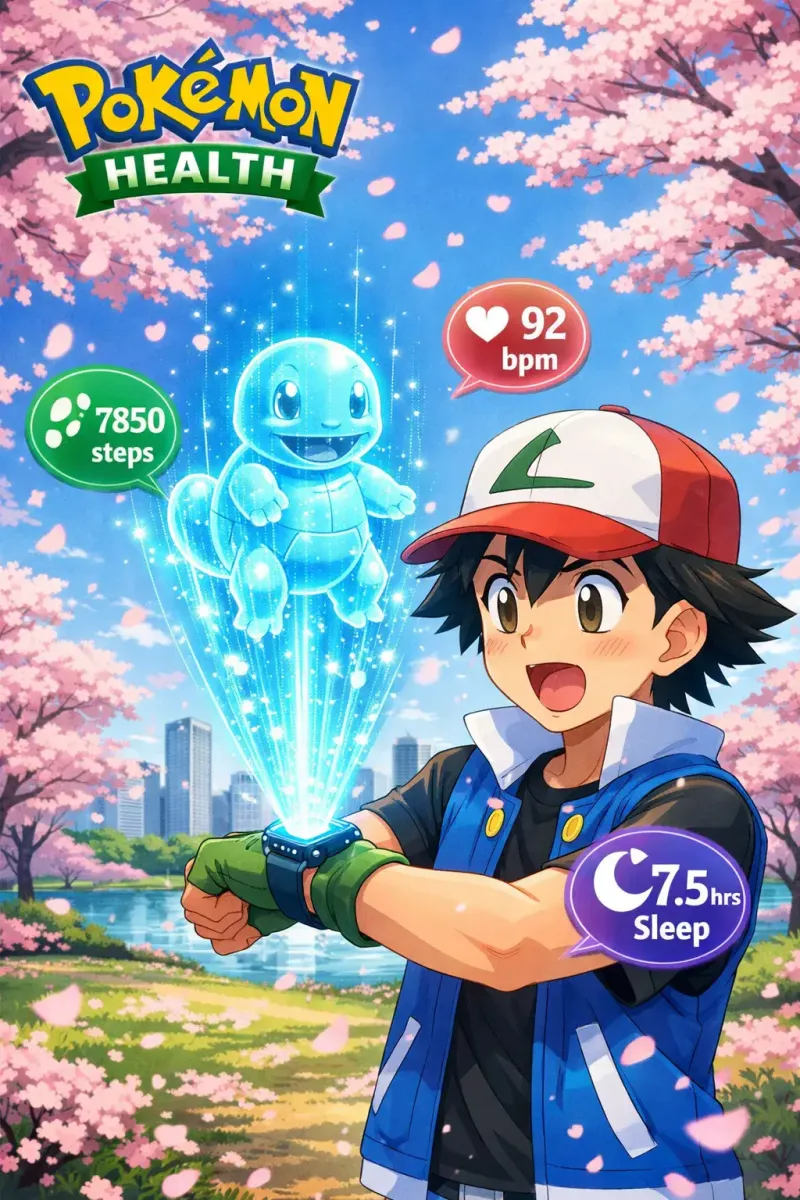
Your biometrics, your companion. The wearable becomes the bond.
The concept: connect a wearable to an app. Your biometric data generates a unique Pokemon. It evolves based on your real-world health behaviors.
Not a generic avatar. A companion born from YOUR data.
Resting heart rate, sleep patterns, activity levels, stress markers. All of it becomes its DNA. Your Pikachu doesn’t look like your neighbor’s because your body doesn’t look like theirs.
How it works:
Walk 8,000 steps? Your Eevee gains energy. Sleep 7 hours? It recovers. Three days of inactivity? It doesn’t die (that would be cruel and counterproductive), but it visibly slows down. Its colors fade. It looks tired.
The key insight is dense reward design. Preventive health has a fatal flaw: the reward is invisible. “You reduced your cardiovascular risk by 3% over 10 years.” The brain can’t process this. Too abstract, too distant.
Pokemon solved this decades ago. Every battle gives XP. Every evolution is visible. Every level-up feels earned. The feedback loop is immediate, tangible, emotional.
| Game mechanic | Health equivalent |
|---|---|
| XP from battles | XP from daily movement, sleep, nutrition |
| Evolution at level thresholds | Visible Pokemon transformation at health milestones |
| Type advantages | Personalized strengths based on individual biomarkers |
| Pokedex completion | Health behavior diversity (not just steps, but sleep, food, mental health) |
| Pokemon Center healing | Recovery days integrated as positive mechanics, not failure |
And evolutions wouldn’t be fixed. Your Eevee evolves based on YOUR habits. You run every morning? Flareon. You meditate? Espeon. You swim? Vaporeon. Your lifestyle sculpts your Pokemon.
The Pokemon must feel alive. Not a progress bar with eyes. Something with personality, moods, preferences. A Snorlax that curls up when you nap. A Machop that cheers you on when you chain push-ups.
Modern AI makes this possible. A companion powered by behavioral AI could adapt its personality to your patterns. Learn what motivates you. Be playful when you need encouragement and calm when you need rest.
A companion. Not a coach.
Level 2: Food as adventure
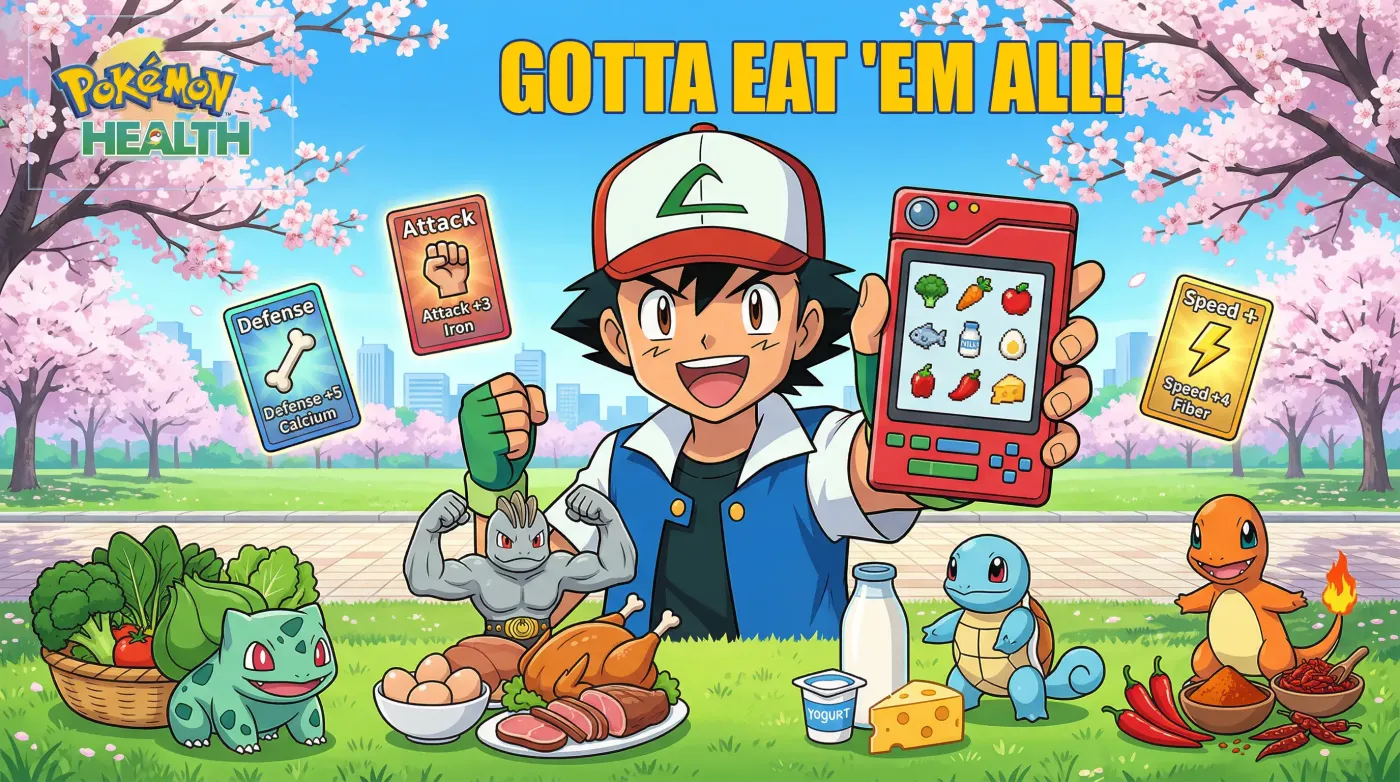
"Gotta eat 'em all." Every real food becomes a Pokedex entry.
The concept: turn nutrition into a collection game. Every real food you eat becomes an entry in your personal Pokedex. Balanced meals unlock combinations, recipes become “moves,” and your Pokemon evolves differently based on what you feed it.
Nutrition apps are boring. Scan a barcode. See a calorie count. Feel guilty or virtuous. Forget about it by dinner. The entire model is built on restriction and guilt, two emotions that are spectacularly bad at sustaining behavior change.
Now imagine this instead.
You eat a sardine. Your Pokedex registers “Sardine, Omega-3 type, Protein class.” Your Pokemon gains a resilience boost. You eat broccoli. “Broccoli, Fiber type, Antioxidant class.” Its defense goes up. Combine both in the same meal? Combo bonus. It learns a new move: “Mediterranean Shield.”
Sounds childish?
It’s exactly how the brain works.
Collection mechanics activate the same dopamine pathways as discovery. Every new food is a new “catch.” Every balanced meal is a strategic choice. The guilt model (“you ate too much sugar”) is replaced by a curiosity model (“what happens if I try this food I’ve never had?”).
The nutritional data is real. The framing is play. The behavioral outcome is the same: people eat better. But they actually enjoy doing it.
For kids, this is transformative. A child who refuses vegetables is not irrational. Vegetables taste worse than candy and the health benefit is invisible. But a child who knows that broccoli gives their Bulbasaur +5 defense? Completely different calculation.
Pokemon Bento: real-world meal kits designed as feeding quests. Not “eat your vegetables.” Instead: “Your Pokemon needs Grass-type energy to evolve. This bento has three Grass-type ingredients. Feed it.”
Same nutrition. Completely different experience.
The science says yes
Pokemon GO and physical activity:
- +26% physical activity in the first 30 days
- 144 billion steps walked collectively
- Players 3× more likely to reach 8,000 steps/day
Gamification in health (meta-analyses):
- 16 RCTs, 2,407 participants: effect size g=0.42 on physical activity, sustained at 14 weeks
- Gamified apps vs. non-gamified: +489 steps/day, −0.28 kg/m² BMI (36 trials, 10,079 participants)
- Serious games for mental health: g=0.55 (9 RCTs, 674 participants)
Clinical serious games:
- Re-Mission (cancer): improved adherence and quality of life
- EndeavorRx: FDA-approved digital therapeutic for ADHD
The evidence is randomized, controlled, and replicated. What’s missing is not the science. It’s the franchise powerful enough to make this work at scale.
Pokemon has 1 billion fans. No health intervention in history has had access to that kind of emotional infrastructure.
What’s really at stake
Franchises that carry emotional weight at this scale, for this long, across this many continents, are rare. Disney. Star Wars. Pokemon. You can count them on one hand.
If a cultural infrastructure of that size did not, at least once, step up to serve a public health issue, when would it ever?
We’re not talking about a marketing idea. We’re talking about what shared culture can do for care, once we stop treating care like paperwork.
Beyond the first two levels
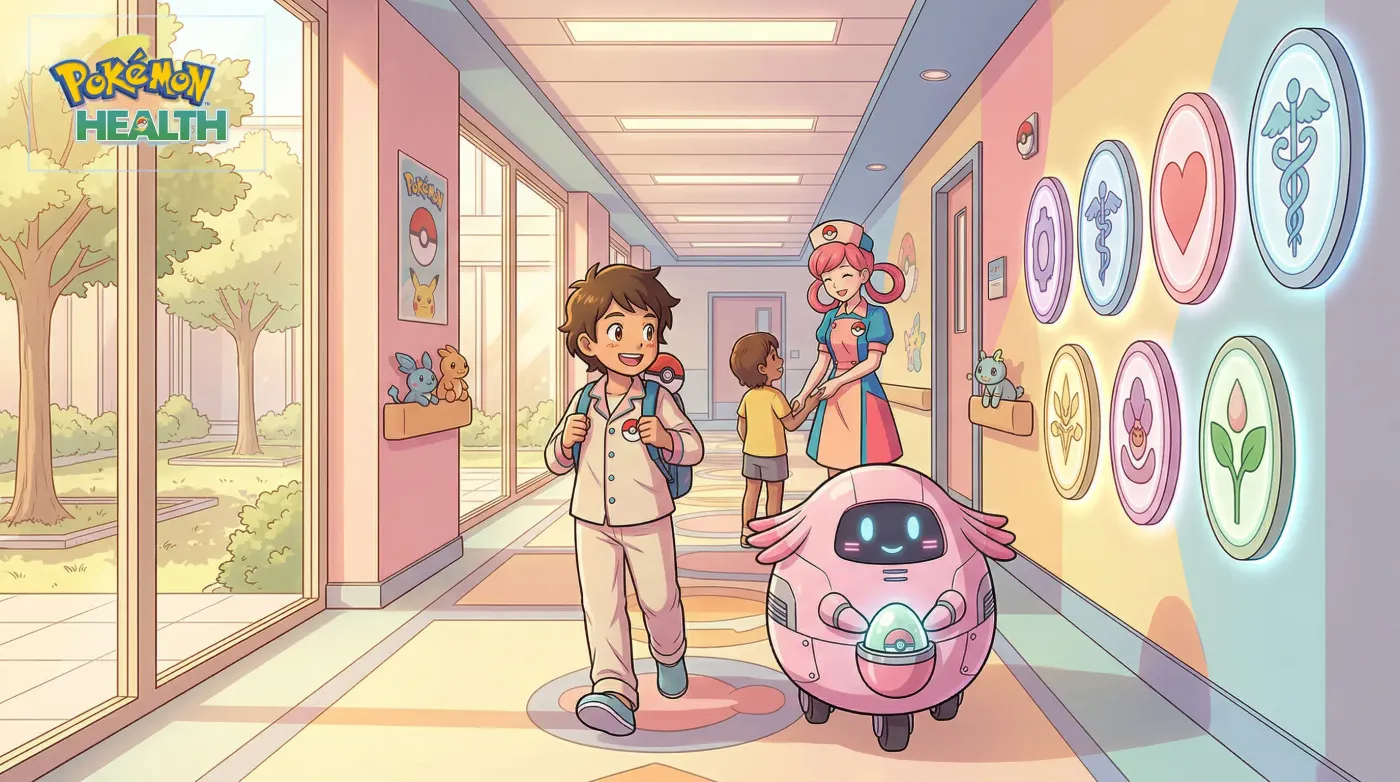
A PokeCenter as your local hospital. Nurse Joy. Chansey robots. Pediatric care, reimagined.
The full vision goes further. A mental health layer where your Pokemon reflects and helps regulate your emotions. A genomics layer where its DNA mirrors your actual genetic profile. A public health layer where real-world health locations (parks, pharmacies, hospitals) shape its evolution, rewarding behavioral diversity, not just movement volume. A clinical layer where treatment journeys become trainer quests. A research layer where clinical trials become community quests.
Ten levels in total. Each builds on the previous.
But the first two are enough to prove the concept. A Pokemon connected to a wearable that evolves with your health. Nutrition as collection.
If it works at level 1, everything else follows.
Why this needs to exist
Pokemon already has the emotional infrastructure. The lore already speaks the language of care. The behavioral patterns already match what health science needs.
The world’s most beloved franchise has never been connected to the field that needs it most.
“Gotta catch ‘em all” could become “Gotta heal ‘em all.”
This isn’t for tomorrow. This isn’t simple. It will take a franchise willing to extend its mission beyond entertainment, doctors willing to recognize that popular culture can be a serious vector of care, and teams that understand the trainer-Pokemon relationship has to be respected before it can be monetized.
But the moment when the idea stops being a joke and starts becoming an obvious next step, that moment is now.