TL;DR. High-level cooking has solved, in its own way, problems that care practice still carries: preparing before the rush, coordinating a team under pressure, reading the signals nobody verbalizes. This article transposes three of those skills to care, with concrete exercises applicable this week. First article of a series of transfers.
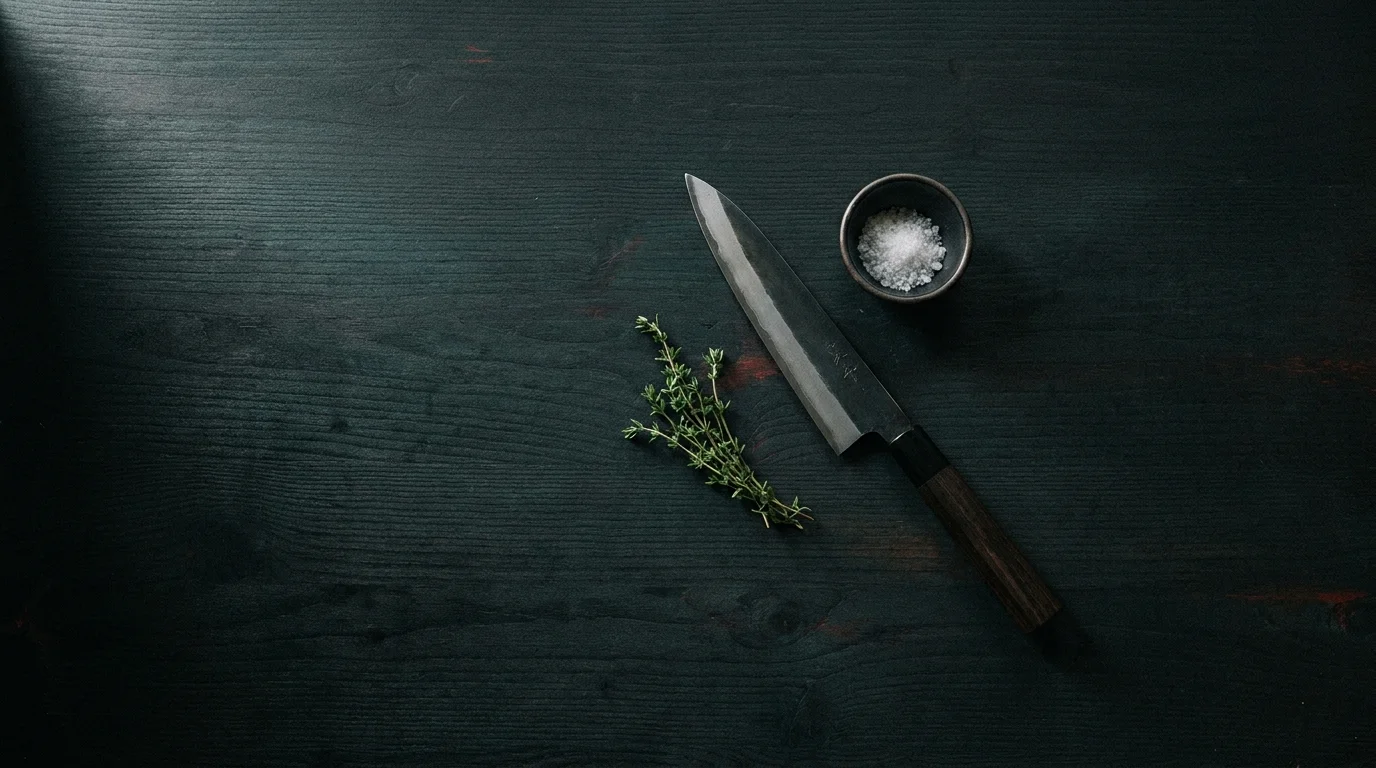
Mise en place. Before service begins.
A brigade, an emergency department
Watch a fine-dining restaurant kitchen during service. A brigade of twelve, synchronized to the second, plates going out every twenty seconds, mistakes caught in silence, a tension contained and mastered.
Now watch a hospital emergency department on a Friday night. A team of twelve, patients arriving every three minutes, protocols to follow, the unexpected to absorb, a tension contained and mastered.
The two worlds don’t speak to each other. Yet they solve the same problem: deliver quality performance, as a team, under time pressure, without error. And they do it differently enough that each has decades of lead over the other, on specific points.
This article takes three skills from high-level cooking and transposes them to care practice. Not to look nice. So you can try one this week.
Why look elsewhere
Medicine looks for its answers inside itself. It’s reassuring, it’s what we ask of it, it’s what its rigor demands. But it closes the door on half of the good ideas. Many trades have, in their own way, solved problems we keep carrying without seeing them. Cooking is one, and not the most obvious.
Like care, it produces a collective performance under pressure. Like care, it combines sharp technique, sensory intelligence, and human management. Like care, it fails spectacularly when one of these three floors collapses. But on certain planes, it has more documented experience than we do. It would be a waste not to look.
The rule of transfer stays simple: we look for a pattern that works elsewhere, we understand what makes it work, and we translate it into the vocabulary of care without making it betray anything. Here are three patterns that struck me.
1. The mise en place
In cooking, everything is decided before service. For four to six hours, the brigade cuts, prepares, portions, aligns. Every ingredient in its place, every sauce on standby, every tool within reach. It’s called mise en place. A chef will tell you without hesitation that a service without mise en place is a service lost in advance, regardless of the cooks’ talent.
The rush itself lasts only an hour or two. The mise en place lasts five. It’s a ratio nobody argues with.
What care does with it (or doesn’t)
The caregiver, on the other hand, often chains without explicit mise en place. The consultation opens on a file discovered in real time. The ward round is improvised in the corridor. The shift starts on the handover of an exhausted colleague. The team briefing, when it exists, is often compressed into three minutes standing up.
There is mise en place in care. It’s just unrecognized, unritualized, often squeezed into the cracks between two surprises. Which means it doesn’t happen, or happens incomplete.
What you can try this week
- Ten minutes alone, before the first consultation of the morning. Files read, key questions noted, likely surprises anticipated. Not with a coffee in hand, chatting with a colleague. Alone, seated, focused.
- Five minutes of team briefing at the start of the shift. Not a meeting. A roundtable: who does what today, who has a heavy case, who’s training. Same format as a chef reading the evening’s menu to the brigade.
- A personal mise en place checklist. Simple, kept up to date, tailored to your post. Emergency kit verified, software open, prescription pad within reach, phones charged. Whatever you want. What matters is that it exists and that it’s done before, not during.
2. The brigade and communication under pressure
We like to tell ourselves care is an art. Under pressure, we improvise more than we admit. I once saw, one night in a ward that ran well, three seniors end up arguing for five minutes because nobody had said who was leading. Everyone was leading. So nobody was leading, really.
In a high-level kitchen, hierarchy is clear and accepted. Chef, sous-chef, chef de partie, demi, commis, dishwasher. Each knows their place, their role, their rights, their duties. Under pressure, nobody improvises their role. You can improvise a dish, never your post.
Communication is codified to the word. “Three starters away.” “Yes chef.” “Fire two tables.” “I’ve got the sauce.” The language is minimal, precise, always acknowledged. No ambiguity possible at the moment twelve burners are lit.
And outside the rush, the brigade becomes a horizontal team again. First-name basis, jokes, juniors getting trained. Hierarchy is situational, not identitarian.
What care does with it (or doesn’t)
Emergency and operating rooms culturally have something that resembles a brigade. Elsewhere, it’s blurrier. Roles overlap, handovers improvise, communication under pressure depends on the senior’s personality rather than a protocol. When it works, it’s thanks to an individual. When it breaks, the whole team absorbs it.
We rely heavily on characters, lightly on structures. Kitchens figured out, a century ago, that characters aren’t enough.
What you can try this week
- Codify a mini team vocabulary. Three to five agreed phrases that mean the same thing to everyone (“I’ve got box 3”, “who are you backing up?”, “I’m running 10 late”, “this file is too much for me, can someone take over?”). Written on a post-it near the station if needed. No matter. What matters is that the words mean the same thing to everyone.
- Separate the rush from the rest. During the emergency or the pressure, clear hierarchy, no debate. Right after, back to horizontality. Five-minute debrief, mistakes named, next. The brigades that last are the ones that make this switch cleanly.
- Designate an “expediter”. In the kitchen, it’s the chef or sous-chef who orchestrates the pass. In care, it’s sometimes nobody, or everybody. Defining who pilots the sequence during a rush (who calls, who receives, who prioritizes) changes the texture of a difficult hour.
3. Reading sensory signals
A great chef hears when the sauce starts to reduce too far. They catch, in the angle of a commis’s knife, the moment it’s about to slip. They smell, three seconds before the smoke, that the garnish has tipped. Embodied intelligence, calibrated by ten thousand repetitions. Chefs consider this competence the hardest to transmit, because it doesn’t fit into an equation.
It exists in care too. And it’s largely undervalued.
A nurse walks into the room of a patient she’s been seeing for three days. She hasn’t checked the vitals yet. She walks out, pages the doctor. “Come see her, something isn’t right.” He comes, finds the parameters acceptable. An hour later, the patient decompensates. The nurse saw it before the machine. Every experienced caregiver has this story. Many have also ignored it at least once, because it was “just a feeling”.
The kitchen respects this intelligence. Care tolerates it at best, mocks it at worst.
What you can try this week
- Thirty seconds of silent observation at the start of each consultation. Before speaking. How the patient walked in, how they sat down, where their eyes go, how they breathe. You’ve already been picking all that up without meaning to. Becoming consciously aware of it changes what you do with it.
- A weak-signal notebook. When you catch something you can’t verbalize, write three words. “Something isn’t right with Ms. X.” “The mood on the ward is tense.” Reread once a month. Check what came to be. It’s your personal calibration tool.
- Refuse to dismiss a junior’s feeling. When a resident or a commis says “I feel like…”, don’t answer with “give me arguments”. Answer with “tell me what you see”. Sensory signals need to be received to become formalized. A senior who welcomes them builds solid caregivers. A senior who crushes them builds silent ones.
Bonus: what neurogastronomy teaches care
One more thing, shorter, but it could deserve an article of its own. Neurogastronomy, a field opened by chefs like Heston Blumenthal, lays down a simple fact: flavor isn’t on the plate, it’s in the brain. Food matters, obviously. But the gustative experience results from a construction that also integrates the color of the plate, the texture of the tablecloth, the ambient music, the emotional memory triggered by a scent. All of it enters the perceived flavor.
Transposed to care: care isn’t in the medication, it’s in the global experience. The waiting room, the tone of voice at reception, the light, the perceived wait time, the way the consultation opens. All of it enters the perceived care, and therefore the patient’s adherence, their trust, sometimes even the effectiveness of the treatment.
You can treat perfectly and deliver poor care if everything around is neglected. You can also, sometimes, rescue an imperfect treatment through a carefully-tended global environment. It’s not magic, it’s the biology of a brain that perceives.
Most caregivers know this intuitively. Few structure it. The kitchen has structured it.
What you could try this week (summary)
A single one of these exercises is enough to change the texture of a work week. Don’t try everything at once. Choose the one that resonates most, hold it seven days, observe what shifts.
- Mise en place: ten minutes alone before the morning, five minutes of team briefing at shift start
- Brigade: a mini team vocabulary, a designated expediter during rushes
- Sensory signals: thirty seconds of silent observation at consultation start, a weak-signal notebook reread monthly
One thing. Seven days. You’ll tell me.
Why cooking, and why others will follow
Cooking isn’t particularly magical. It just has, on certain points, more experience than we do. The next transfer could come from video games, aviation, service design, theater, the military, elite sports. Anywhere a trade has solved, in its own way, a problem care keeps carrying without seeing it.
The method, though, doesn’t change: identify a pattern that works elsewhere, understand what makes it work, translate it without betraying what care cannot betray.
Looking elsewhere may be, perhaps, the real caregiving competence of the century to come. Not to copy. To see what we weren’t seeing.
First article of a series. The method and the next transfers are here: Transfert, project page. To not miss the next ones, follow on LinkedIn or X.
If you’ve tried one of these exercises in your practice, write to me. That’s how we build the catalog, not alone.
And if you’re a professional cook or chef, you’re welcome too. You know this transfer better than I do, from underneath. You’ve surely seen caregivers pass through your dining room and recognize, without formulating it, what you do in the brigade. Tell me what you would have seen in my place. The best transfers come from crossing gazes.