TL;DR. Japan has thought, ritualized, and lived relationships to silence, anticipation, and the scar that Western medicine still fumbles with. These aren’t exotic concepts: they’re daily practices that organize architecture, hospitality, repair. This article transposes three Japanese concepts to care: ma (the fertile interval), omotenashi (anticipatory hospitality), kintsugi (repairing by magnifying). With one exercise to try this week per axis. Second article of the Transfert series.
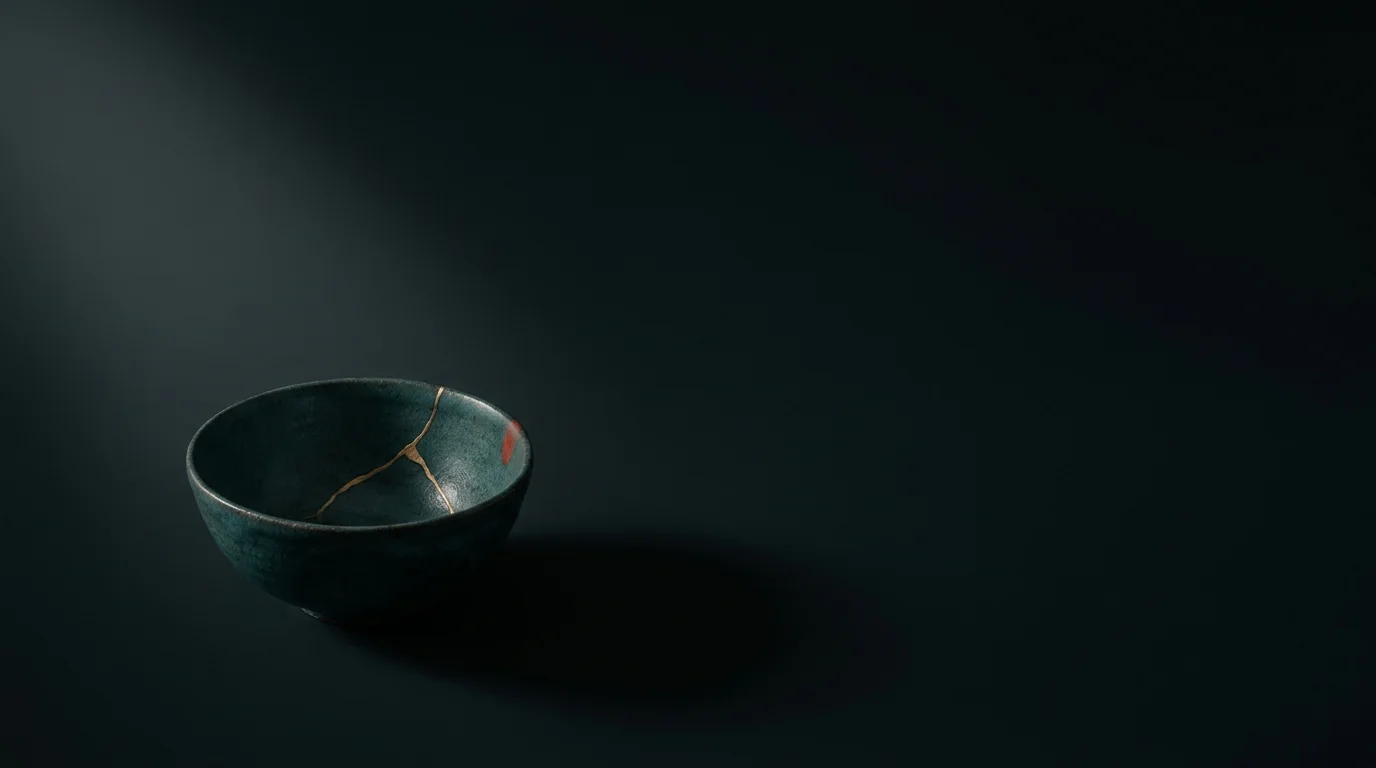
Kintsugi and ma. The object, and the emptiness that holds it.
A Kyoto counter, a hospital corridor
A small shop in a Kyoto side street. You stepped in three seconds ago, you haven’t asked for anything. The woman behind the counter has already placed a small glass of water on your stool. She hasn’t spoken, she doesn’t expect thanks. Elsewhere in the shop, a lived silence, a fluid flow, objects arranged with care you only notice at second glance. Nothing shouts. Everything is in its place.
A hospital ward on an ordinary afternoon. A patient in their room must ring for a glass of water, ring again for a blanket, ring a third time to ask when the doctor will come. In the corridor, voices overlap, alarms, conversations from three meters away that carry twenty. The space is constantly filled. Nobody, anywhere, has had the time to think of what might be missing before someone has to ask for it.
The two worlds don’t speak to each other. Yet they handle the same stake: humans rendered momentarily fragile by the situation, depending on the attention of other humans for their passage to go well. Japan has codified what, in Western medicine, still largely depends on the caregiver’s character.
This article transposes three Japanese concepts to care practice. Not to look nice. So you can try one this week.
Why look toward a culture
Medicine looks for its answers inside medicine. That’s reassuring, that’s what its rigor demands. But it closes the door on half of the good ideas. Some cultures have structured, over several centuries, relationships to attention, emptiness, and repair that we still carry without a frame.
Japan is one of these cultures. Its concepts aren’t esoteric or exotic. They’re ritualized, lived, present in architecture, conversation, hospitality, craftsmanship. Not all of them translate. Some can, on the condition that we respect what care cannot betray.
The rule of transfer stays the same: find a pattern that works elsewhere, understand what makes it work, and translate it into the vocabulary of care without making it betray anything.
1. Ma: the fertile interval
Ma (間) is the interval. The distance, the duration, the emptiness between two things. It isn’t nothingness, but a space-time that connects as much as it separates. In Japanese architecture, ma is the breath between rooms. In nō theater, it’s the pause between two lines, often longer than the lines themselves. In music, it’s the silence that makes the previous note exist. In conversation, it’s the space left to the other person so they can land.
What matters, Japanese aestheticians say, isn’t only what is placed. It’s the breath the interval grants. Form only fully exists with the emptiness that allows it to emerge.
What care does with it (or doesn’t)
Western medicine fills. More exams, more words, more recommendations, more written supports. The consultation is dense, the round quick, the room noisy, the corridor crowded. Very little space remains, in a day of care, where a patient can land between two pieces of information, two decisions, two waves. We’ve called “care management” what is also, sometimes, a saturation.
The patient doesn’t only need information. They need time for that information to find a place inside them. That time is ma. And it has become rare.
The Western caregiver verbalizes to reassure. Japan knows that we can also reassure through what we don’t say.
What you can try this week
- Three seconds after a question, before rephrasing. You’ve just asked the patient a question. Resist the urge to rephrase it within the second. Count three seconds of silence. In most cases, the answer arrives in the pause.
- A deliberate pause after heavy information. Announce, then a silence of five to ten seconds before continuing. Look at the patient. They’re landing. You don’t have to fill that time.
- A gesture without words. Placing a hand, closing the file, a standing pause before sitting down. Every gesture of care can have its ma. One per day, without forcing.
2. Omotenashi: anticipate rather than serve
I’ve spent quite some time in Japan, on several trips. What struck me, in the restaurants, the shops, the inns, wasn’t spectacular service. It was the opposite. A permanent but invisible attention that means you almost never have to ask for anything. The glass is filled before you notice. A slipper is ready in your size before you’ve taken off yours. An umbrella is offered when it rains, without being asked.
It isn’t zeal. It’s an ethic. Omotenashi (おもてなし) is the art of anticipating others’ needs with discretion, to spare them having to ask and, in doing so, preserve their dignity in the exchange. The person serving doesn’t seek to be seen. They seek to ensure that the guest never has to beg.
What care does with it (or doesn’t)
A hospitalized patient spends their day asking. A glass of water, a blanket, an appointment, an explanation, a time. Every request is a micro-surrender: they are forced to formulate a need, and therefore to accept being in a position of dependence. This succession of surrenders, over a day, a week, a month, weighs on the patient’s dignity at least as much as the illness itself.
Omotenashi isn’t a customer-service culture pasted onto the hospital. It’s a way of thinking care as a silent anticipation. It changes the texture of a room before you even enter it.
Preserving a patient’s dignity often means sparing them having to ask.
What you can try this week
- One minute of mental preparation before entering a patient’s room. List what they might want in the next twenty minutes. A glass of water placed without comment, a curtain cracked open before they ask for light, an explanation given before they ask the question.
- Anticipate an explanation rather than give it when asked. The patient who doesn’t understand what’s happening ends up asking. The patient to whom it was explained beforehand didn’t have to beg for clarity. It changes their day.
- A post-it in the file, with three patient-specific anticipations. What they systematically ask for, what they don’t dare ask, what keeps them calm. The whole team can rely on it.
3. Kintsugi: integrate the scar
Kintsugi (金継ぎ) consists of repairing a broken ceramic by highlighting its cracks with lacquer mixed with gold powder. The repaired object doesn’t hide its wound. It shows it. It transforms it into part of its history. The bowl becomes more precious after its breaking than before.
What care does with it (or doesn’t)
Medicine often seeks to make the trace disappear. The “everything is back to normal”, the “you can resume your normal life”. For some patients, it’s a release. For many others, it’s a silent injunction to hide what happened, what went through them, what they will never be again.
Kintsugi proposes another register. Not deny the scar. Integrate it, name it, honor it. The patient is no longer “like before”. They are now this: someone who has crossed through, and whose story is richer because it includes that passage.
We like to believe we care well when we erase the trace. Sometimes, we care better when we help the patient make something of it.
What you can try this week
- Stop saying “everything is back to normal” automatically. Replace with “you’ve crossed through something, how are you living with what remains?”. Listen to what comes.
- Ask an integration question in follow-up consultation. “What has this episode changed for you?” Not a medical question. A question of history.
Bonus: shinrin-yoku
Shinrin-yoku (森林浴), or forest bathing, is a Japanese practice recognized as beneficial for physical and mental well-being. It isn’t about doing sports in a forest. It’s about letting yourself be traversed by an atmosphere, sounds, smells, a non-urban temporality.
Measurable effects on stress, blood pressure, and immunity are starting to be documented. Caregivers working in the red for months might have as much to gain from it as their patients do. This will likely be the subject of a future transfer: what therapeutic nature can teach care.
What you can try this week (summary)
A single one of these exercises is enough to change the texture of a work week. Don’t try everything at once. Choose the one that resonates, hold it seven days, observe what shifts.
- Ma: three seconds of silence after a question to the patient, before rephrasing
- Omotenashi: one minute of mental preparation before entering a room, with three anticipations listed
- Kintsugi: an integration question to ask during a follow-up consultation (“what has this changed for you?”)
One thing. Seven days. You’ll tell me.
Looking elsewhere, again
Japan isn’t magical. It just has, on certain relationships to attention, emptiness, and repair, a few centuries’ head start. Other cultures, other crafts, other practices carry patterns just as useful to care. Stoicism in the relationship to pain. Dance in the relationship to the body. Aviation in communication under pressure. Each in its own time.
The method, though, doesn’t change: find a pattern that works elsewhere, understand what makes it work, translate it without betraying what care cannot betray.
Looking elsewhere may be, perhaps, the real caregiving competence of the century to come. Not to copy. To see what we weren’t seeing.
Second article of the Transfert series. The method and the other transfers are here: Transfert, project page. To not miss the next ones, follow on LinkedIn or X.
If you’ve tried one of these exercises in your practice, write to me. That’s how we build the catalog, not alone.
And if you’ve lived Japan other than as a traveler, if you work there, grew up there, studied there, you’re welcome too. Tell me what I mistranslated, what I oversimplified, or a concept I should have chosen instead. The best transfers come from crossing gazes.