TL;DR. ATLAS is a sovereign AI assistant installed at our place, inside a 50-person radiotherapy center. No cloud. No clinical decision-making. No diagnosis. Just a box the size of a shoebox, an NVIDIA DGX Spark, running in a closet and starting to give back to care the time bureaucracy steals from it. We started with radiation therapy consultation reports. The rest is coming. Build in public on LinkedIn and X.
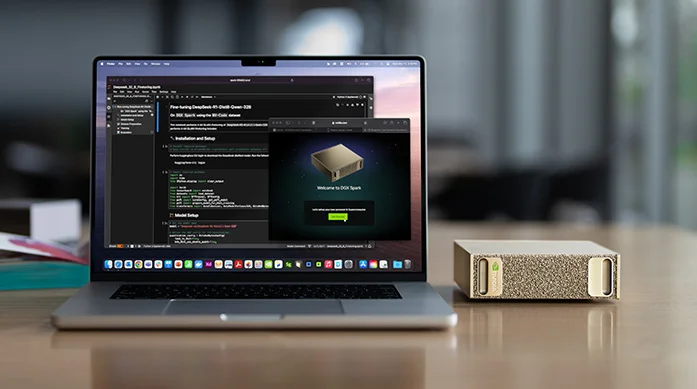
The hardware featured in the ATLAS project.
Ten minutes
It’s 12:40 pm. My 11 am consultation is still in the waiting room. Two more behind her. My lunch break, in theory, is now.
And I still have three consultation reports to type.
Ten minutes per report. Not because they’re complicated. Because I need to pull up the imaging, copy the staging, write the synthesis, proofread it, correct the dictation typos. Thirty minutes of work for three patients I’ve already seen, already listened to, already examined.
The choice is quick. Either I eat, or I see the next patient. Most days, I see the patient. At the front desk, the secretary runs the same arithmetic: her appointment confirmations, her synthesis letters, her follow-ups on missing files, she handles them on her break.
Ten minutes in front of a screen to write a report is ten minutes I’m not spending on care. Or ten minutes taken from lunch, from the pause, from the breathing space that makes the afternoon sustainable.
It’s arithmetic. Those ten minutes don’t come back. They don’t go to the next patient. They don’t go to the team. They don’t go to the time it takes to explain, to reassure, to think through a difficult case.
I started looking for another way. Not a consumer tool. Not a cloud AI. Something that runs at our place, that understands our work, and that never leaves the center. That became ATLAS, short for Assistant de Traitement et de Liaison pour l’Aide en Santé (Treatment and Liaison Assistant for Healthcare Support).
In Greek mythology, Atlas is the Titan who carries the vault of the sky on his shoulders. I did not choose that name by accident.
Why we built it
The non-negotiable constraint: sovereignty
In our radiotherapy center, patient data does not leave. Not to the cloud. Not to an API. Not to an American subcontractor who’d host the conversation to “improve their model.”
This isn’t an opinion. It’s a regulatory obligation, an ethical duty, and a personal conviction. The day a patient file leaks through a consumer AI is the day the entire trust of care starts to crack. We’re well past theoretical risk: French medical practices have already seen their ChatGPT accounts indexed by search engines, with prompts containing patient names.
European regulation on health data is among the strictest in the world. That is a very good thing. It is also, sometimes, a real brake on medical innovation: between an idea and a clinical experiment, you have to navigate a forest of legitimate but heavy obligations. GDPR, data protection impact assessments, legal basis, retention periods, subcontractor contracts, transfers outside the EU. Every cloud layer adds a compliance layer, and often a reason to push the project to the next quarter.
ATLAS answers this tension with radicality: 100% local, on-premise, disconnected from the internet. No cloud to audit. No subcontractor to qualify. No outbound data flow to justify. The server sits in a technical closet of the center, plugged into the internal network, cut off from the rest of the world. Innovation happens in a setting where compliance stops being a brake: the infrastructure itself carries the compliance.
For ATLAS, sovereignty isn’t a marketing angle. It’s the founding axiom.
The real pain: administrative friction
Next to that, there’s the other reality. Every role in the center has its ten minutes stolen daily.
- Physicians write reports, search documents inside the patient file, proofread letters.
- Medical physicists reconcile data between two software systems that don’t talk to each other.
- Radiation technologists juggle a planning schedule nobody has the time to optimize.
- Secretaries rewrite the same appointment letter twelve times because the Word template is outdated everywhere.
- Management tries to understand cash flow inside an Excel file that’s mutated over ten years.
Each friction taken separately feels tolerable. Stacked across 50 people, across a week, it becomes the real glass ceiling of care.
What ATLAS is not
Here is the stance that shapes the entire project:
AI in care can transform it without doing diagnostic work.
ATLAS isn’t trying to diagnose better than I do. It doesn’t segment tumors. It doesn’t predict doses. It doesn’t suggest treatments. These are real topics, but they’re other projects, with other validation frameworks, other teams, other responsibilities.
The bet behind ATLAS lies elsewhere: transform care by amplifying every link in the system around the patient, not by replacing clinical decisions. If the secretary is supported, the patient gets a better welcome. If the physicist is supported, dosimetry moves faster. If the doctor is supported, there’s more time for the next patient. It’s integrative medicine. Not everything for the patient directly, but everything converging toward their benefit.
Not wanting to replace the physician isn’t a weakness. It’s the useful scope.
What it does today
We started where the pain is most concentrated and most shared: radiation therapy consultation reports.
A first-consultation report in radiotherapy has structure. History, clinical exam, staging workup, therapeutic decision, target volumes, prescribed dose, fractionation scheme, follow-up. Each field has its rules, each field has its traps. It’s repetitive, it’s codified, and it’s exactly what AI can do well if you guide it properly.
We started with the most frequent sites: prostate and breast. Together, they represent a large share of the daily volume. Each report template was methodically broken down: what information is needed, where to find it inside the patient file, in what order to assemble it, in what shape to make it readable.
This isn’t a gadget we plugged in hoping it would work. It’s a patient, methodical effort where every template is tested, reviewed, corrected against real cases. For now, I read and sign every generated report before it goes out. We build trust before we scale.
Other building blocks are already waiting their turn inside the tool. Some will make the documents arriving at the center immediately usable by the team. Others will free the secretary from a letter she rewrites twelve times a week. Others still will barely touch my work as a doctor but will change the day-to-day life of the physicist next door.
We open them progressively, role by role, so each person has time to absorb what concerns them. The details, the mechanics, and the backstage, that’s the material of the next articles in the series.
What it will do
This is where the vision clicks into place. ATLAS isn’t designed as yet another central tool. It’s designed as infrastructure that every role will appropriate, at their own pace, with their own use cases.
For physicians
Beyond the initial consultation: weekly follow-up reports, end-of-treatment reports, letters to referring colleagues, tumor board synthesis, contextual search inside a patient’s file before consultation.
For medical physicists
Automated data extraction between the software systems that don’t talk to each other, help in building internal tools, protocol reviews.
For radiation technologists
Planning optimization that accounts for skills, shift slots, treatment types, emergencies. Not an AI that decides. A tool that proposes a distribution the team validates.
For secretaries
Generation of standard letters (appointment notices, confirmations, reminders), help with medical billing codes, search through administrative references.
For management
I co-direct the center with several partners and a managing director. None of us physicians holds a management degree. We all learned on the job, by doing, by failing, by adjusting. Running a 50-person oncology structure is a full-time job in itself, and we do it on top of our own.
ATLAS should give us a 360° view of our business: cash flow, activity indicators, dashboards, improvement paths. Not to decide in our place. So we can decide better, with a reading of reality that nobody has the time to reconstruct by hand every week.
The goal for the next six months is simple: more than 30 hours of AI training for the 50 people in the center. The whole company has to level up, not just the technical teams. Education is the number-one success factor of an AI project in a company. Before the technology, before the budget, before the tool itself.
Once trained, everyone gets the same assignment: look for their own frictions in their daily work for six months, then build the tools that lift them. Each person gets to shape, as much as they can, the work environment they want to thrive in. ATLAS isn’t a product. It’s a workshop.
The infrastructure, for real
The heart of ATLAS fits inside 15 centimeters.
An NVIDIA DGX Spark Founders Edition. 128 gigabytes of unified memory. 1,000 TFLOPS of AI compute. A 4-terabyte SSD. A 1.2-kilo mini-PC running a specialized Linux, sitting in a technical closet of the center, plugged into the internal network, and nothing else.
Around this machine, a dozen or so software building blocks assembled locally: an engine that runs the AI models, an automated reader for incoming documents, a voice transcription system, a serious authentication layer to filter who can do what, a custom interface for the team. Nothing revolutionary taken separately. The whole value is in the assembly, and in the fact that the whole thing fits within the walls of the center.
No data leaves. No external API is called. The models run locally. When a request comes in, it’s processed on-site, the response is returned on-site, and nothing persists beyond what the user decides to keep in the patient’s file.
It’s less flashy than a GPT-5 in a browser. It’s infinitely safer.
What we carry
We’re not adding one more brick to the shelf of tools in the center. We’re installing an infrastructure that will irrigate every role, every workstation, every friction of the daily grind. Today, it’s a report. Tomorrow, it’s an entire consultation. In five years, it’s the invisible backbone of the center, the one that carries the rest without being seen.
Nothing we do will be spectacular. Everything will be structural.
The team
ATLAS isn’t a solo project.
-
Gregory Messador, the center’s IT lead, holds the infrastructure. Docker, networking, deployment, backups, migration. He’s the one who built the first working prototype before the DGX Spark even arrived, on a modest server, so we could test, iterate, correct. When the Spark landed, we already had a working tool.
-
Mario Pazzola, medical physicist and physics project lead, develops the physics-side prototypes and writes code. He also carries the topics where physics meets software, typically the technologist planning solver.
-
Karim Dekkar, Oncodoc’s HR director, is the designated Data Protection Officer. He locks down GDPR compliance, the AI impact assessment, the legal basis. His role is critical: without him, no patient-data use case can ship to production.
-
And me, Julien, I carry the vision and the articulation with the rest of the center. More importantly, I inject the medical experience of the field into every AI brick. That’s what no tech team can bring in our place: knowing what really matters inside a consultation, inside a file, inside a report being signed. Without that clinical anchor, you build an impressive tool that misses the target.
A tight technical trio, used to collaborating on projects that combine medicine, physics, and software. And a simple operating rule: everyone prototypes in their own domain, we share what works, we document what fails, we move forward.
What’s already changing
We don’t have hard published metrics yet. We’ve been building for only a few months. But there are signals.
A consultation report for a prostate cancer, generated from the patient file in under two minutes, reviewed and corrected in two more, signed. Four minutes instead of ten. Multiplied by the consultations of a single day, then by the physicians, then by the weeks.
This isn’t a spectacular gain on an isolated case. It’s a structural gain that, compounded, changes the texture of a workday.
And there’s an effect I hadn’t anticipated: the team has started to think in AI terms. Secretaries propose their own use cases. Technologists ask whether a given step of their journey could be lightened by the tool. Physicists identify their own frictions to automate. ATLAS is becoming a culture, not just a tool.
What’s next
The next six months are already mapped.
V2 (in progress): prostate and breast consultation reports in production, progressive extension to other sites, voice dictation deployed in consultation, automated reading of incoming documents.
V3 (summer–fall 2026): an automatic safety net that checks every file before treatment. Because in radiotherapy, a human error can cost a life. We work on it with method and humility.
V4 (end of 2026 and beyond): the natural extension of the report pillar, the opening to roles still underserved, and above all the uses that will emerge from the training itself. It’s this last point that interests me the most.
The heading is clear: a sovereign AI that amplifies every link of the system, that respects the scope of what it does well, and that never encroaches on medical decisions.
And if it works, the model can leave the center. Other healthcare structures have the same frictions, the same constraints, the same regulation, the same letters rewritten twelve times a week. ATLAS isn’t thought of as a product to sell. It’s thought of as a reproducible blueprint. What we’re building here could one day carry a part of the daily work of dozens of other teams.
Why I’m telling all of this in public
Because I’m building ATLAS in public. Not the sensitive technical details, not the patient data, not the closed code. But the decisions, the pivots, the doubts, the moments when we wonder whether we’re doing the right thing.
What I document on LinkedIn and X is the story of a radiotherapy center trying to integrate AI without betraying care. If it helps other teams get started, and especially avoid the wrong turns, it’ll have been worth something.
Follow ATLAS build in public: LinkedIn · X
Read also: ATLAS, project page · Miroki, the crying child, and the robot that handed me a towel