
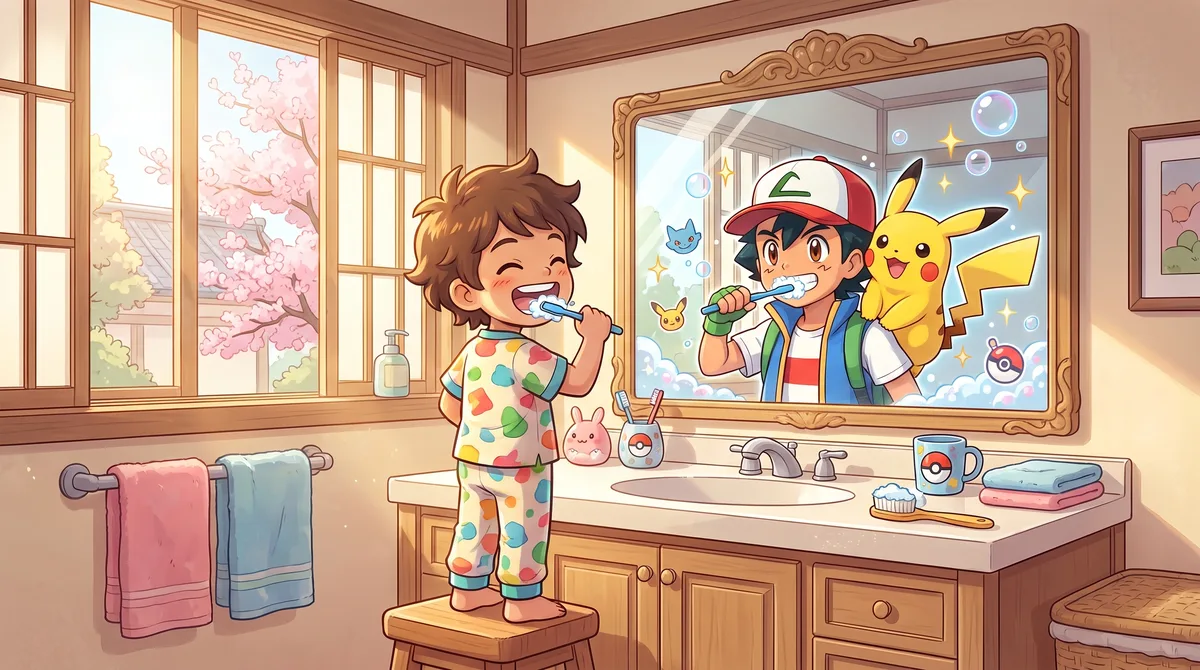
What Pokémon Smile does
Pokémon Smile uses the camera to detect the face and movements during brushing. The screen guides the user towards different areas, while the game features Pokémon to rescue. The action is paired with a timer and a collecting reward.
The Japan Dental Association contributed to the advice displayed in the app. It also highlights the parent’s role in a child’s brushing. A professional association can help develop accurate content; measuring the app’s effect then requires a study. Japan Dental Association.
The tool was developed with LITALICO. This partnership tells us about its design and the attention paid to the user experience. On its own, it does not establish particular effectiveness in people with a developmental disorder. Presentation of Smile’s development with LITALICO.
The first evaluations
A 2023 study compared brushing sessions in seven five-year-olds. It observed a statistically significant reduction in plaque after the app session, while the reduction after usual brushing was not significant. Establishing superiority, however, requires a direct comparison of changes between conditions. “Significant here, non-significant there” is not enough. The sample remains very small. Hwang, 2023.
In 2025, a study involving sixteen autistic children reported improved brushing behaviour after five days supported by caregivers. The questionnaire concerns the surfaces brushed, as reported by caregivers. It does not directly measure plaque or tooth decay. There is no control group, and the protocol excludes children with co-occurring conditions including ADHD, anxiety or depression. The result therefore cannot be extended to those situations. Putri, 2025.
A 2026 study in Depok involving 32 schoolchildren reports a reduction in plaque index after five days. The abstract describes a single group before and after use, without a control. The app, adult attention and repetition of the action cannot be separated in this protocol. Depok study, 2026.
An earlier Indonesian thesis involving thirty children assessed simulated actions using a checklist. It forms part of the history of evaluation, with the status of a thesis and the limitations of a before-and-after protocol. Fatonah’s thesis.
Another Indonesian diploma thesis, dated 2025, reports improved brushing actions in thirty students after using Smile, without a control group. The institutional abstract was read; the chapters detailing methods and results have restricted access. This signal does not demonstrate a clinical effect attributable to the app itself. Sinaga, Medan thesis, 2025.
These studies open several avenues. They do not yet answer questions about children’s independence, technical quality, gum health or cavity prevention in the same way. The guide keeps these outcomes separate.
An app within a local programme
In Fukuoka, a programme for first-year primary school pupils combines brushing, stickers applied by parents and a free dental check-up after thirty stickers. For the 2026–2027 campaign, the app is part of a broader programme that also has a paper option. The dentist, parents and participation arrangements are part of the intervention. City of Fukuoka.
This arrangement raises a different question from an individual download: does Pokémon help a family enter and continue along a prevention pathway? Participation, continuity of brushing and dental outcomes would need to be measured, also examining who uses the paper option.
Uses beyond childhood
Adults describe using Pokémon Smile to make brushing easier to start, particularly in ADHD communities. The timer and visual cues seem useful to some participants. These accounts tell us about needs and spontaneous adaptations; they do not evaluate the app as a treatment for ADHD. Accounts of Smile and brushing in an ADHD community.
Handwashing songs, toothbrushes and illustrated materials belong to the same family of connections with daily life. Their presence in the catalogue means that they exist. Fewer infections, better technique or a lasting habit would require specific measures.