
Preparing for an MRI
Preparation material may be useful through its explanations, sounds and human support. The characters’ contribution would require comparison with equivalent material: the same content, duration and presentation conditions.
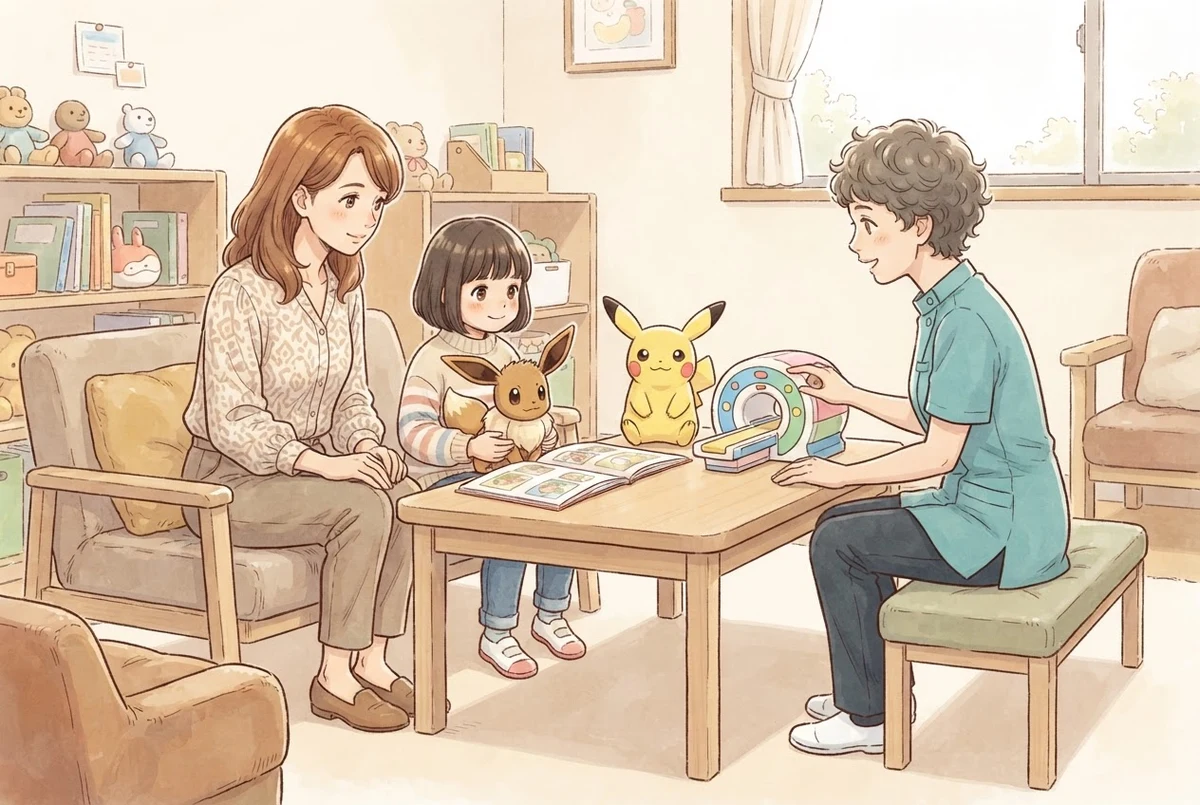
Canon Medical and The Pokémon Company designed a video to prepare children for an MRI. It notably uses real examination sounds and a presentation from a child’s eye level. Characters help explain staying still and the issue of metal objects. The document describes a concrete resource built around the conditions of the examination. Presentation of the Pokémon MRI preparation video, Canon Medical.
Canon’s paediatric page also presents an ultrasound resource. Both resources are documented by the manufacturer; the ultrasound video was not watched during this research. Canon paediatric resources.
Accounts accompanying this kind of project may describe easier examinations. To measure the effect, a protocol should specify age, anxiety, image quality, repeated sequences and sedation arrangements. The video could be compared with equivalent preparation without Pokémon. The result would also depend on the team’s support.
The catalogue therefore distinguishes the resource’s verified existence, healthcare professionals’ experience and evaluated outcomes. This makes it possible to document a promising use without attributing a reduction in sedation that has not been measured in a study presented here.
- HearReal sounds from the examination.
- UnderstandThe importance of staying still during the examination.
- PrepareAn explanation about metal objects.
Distraction during a dressing change
A 2024 paediatric nursing publication describes fifty children aged five to twelve after abdominal surgery, divided into two groups of 25. The experimental group used an augmented-reality Pokémon game for ten minutes during dressing changes. The authors report favourable results for pain and comfort. Sasi, 2024.
Reading the text calls for several qualifications. Assignment was not randomised, the game version was not identified and analgesia management was insufficiently detailed. The reported mean pain score in the control group exceeds the usual range of the cited CHIPPS scale. Aggregation across the two days might explain this, but it is not specified. The guide therefore retains the existence of this exploratory study without repeating its effect magnitude as a reliable finding. Original CHIPPS description.
The question deserves more precise evaluation: does a game adapted to the procedure, age and patient’s position improve their experience compared with another distraction or usual care? The team must be able to interrupt the activity, communicate with the child and provide care under appropriate conditions.
Supporting a return to movement
Johns Hopkins described the use of GO with a young patient after surgery, with staff observations about walking, distraction and relationships. This story shows how a team can integrate a personal interest into everyday hospital life. It does not measure a reduction in length of stay attributable to the game. Account of getting moving again in hospital, Johns Hopkins, 2016.
In a rehabilitation study, the expected outcome would be more specific: mobility, function, pain, fatigue or independence, depending on the situation. The effects of human encouragement, walking and the game would also need to be distinguished. Findings in healthy players do not automatically transfer to the postoperative period.
Resources for paediatric facilities
Pokémon Illust Lab provides illustrations to eligible organisations, including paediatric facilities, under its terms of use. This resource documents organised access to visual materials. It is neither blanket permission to use all Pokémon intellectual property nor a clinical evaluation of the illustrations. Pokémon Illust Lab.
To understand their value in a department, one could study the readability of an instruction, preparation for an appointment or the child’s experience. These objectives do not all require the same measure. The starting point remains the resource’s function in a concrete situation.
Cancer: separating prevention, support and treatment
Connections with cancer take several forms. A campaign may use interest in GO to remind players about sun protection. Donations may support children’s hospitals. A patient may play during treatment. These facts are not evidence of an anticancer effect.
In 2016, the Israel Cancer Association published a campaign for GO players about sun exposure, hydration and safety. The document is a historical source on a prevention initiative. Its advice must be placed in its period and is not reproduced here as a set of up-to-date medical recommendations. Prevention campaign for GO players, Israel Cancer Association, 2016.
The Pokémon Company International is also listed among the sponsors of a Toy Foundation fundraiser for play programmes in children’s hospitals. The total raised does not isolate Pokémon’s contribution or establish specific funding for cancer research. The Toy Foundation announcement, 2024.
Two other initiatives directly concern mobilisation around cancer. Stand Up To Cancer describes a collaboration with Niantic and a week-long activation in GO in July 2024. The 2024 Catch a Million campaign describes a community fundraiser for St. Baldrick’s, which funds childhood cancer research. The first is a partnership described by the organisation; the second does not establish an official partnership with The Pokémon Company. The pages read do not quantify benefits for patients. Stand Up To Cancer; Catch a Million.
Mott Children’s Hospital also described GO use among hospitalised children in 2016, including a child with cancer. The report describes movement and interactions, with attention to other patients’ privacy. It documents use in practice, without constituting a clinical trial. Michigan Medicine.
For oncology uses, exploratory questions may concern the experience of care, relationships, adapted activity or quality of life. Tumour outcomes belong to another level of research. No connection presented in this guide supports recommending Pokémon as a cancer treatment.