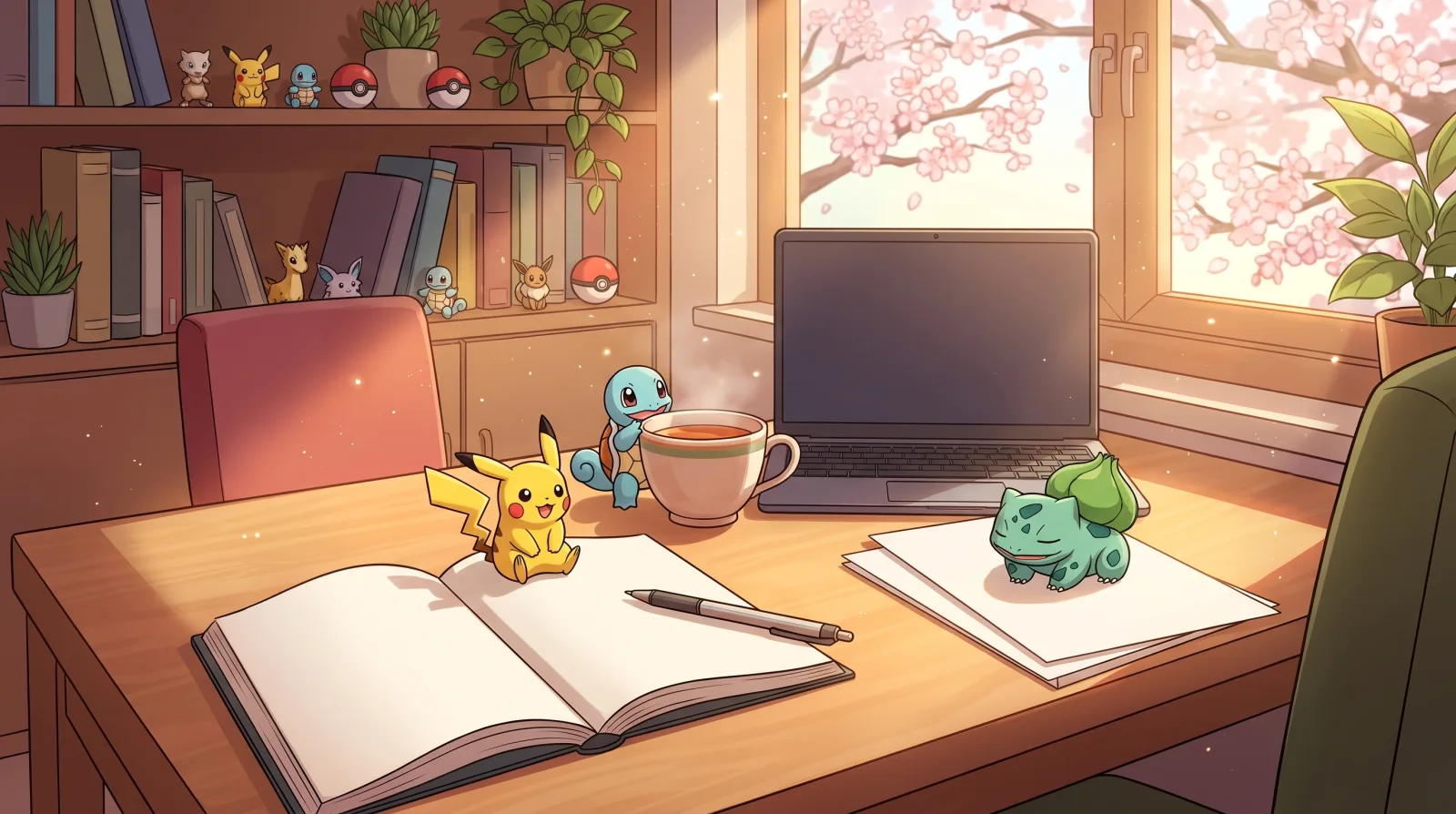
In my office, one look at my bookshelf gives away my geeky side: a few Pokémon, some Poké Balls, a little Lego. One day, someone spotted them and said with a laugh, “I didn’t know Pikachu worked in healthcare.” I laughed too. Then the phrase stayed with me.
I started looking for connections between that world and my profession. There were the familiar apps, and things I had thought less about: a video preparing children for an MRI, blood donation centres turned into PokéStops, characters used to talk about sleep. There were also scientific publications and players’ accounts, which did not always tell the same story.
I wanted to follow the subject far enough to understand its different dimensions. This investigation therefore covers the whole franchise: games, cards, objects and characters, but also what people and institutions do with them. Health here includes everyday habits, the experience of illness and the conditions in which people play.
Pokémon and Health is the name I gave this work. It is a personal investigation, independent of The Pokémon Company, Nintendo, Game Freak, Creatures and the apps’ publishers. Official connections, third-party initiatives and research proposals are identified in the text and catalogue.
What evidence means in this guide
A partnership can be confirmed without its effectiveness having been evaluated. Someone can describe an important experience without it being representative of all players. A study can find a difference between users and non-users without demonstrating that the game caused it.
For each finding, I look at what was observed, in whom, for how long and against what comparison. Download numbers tell us about reach. Steps tell us about behaviour. A dental plaque score tells us about an intermediate clinical outcome. These findings answer different questions.
The effect of the complete game and that of the brand also require separate comparisons. An experience may combine walking, goals, rewards and encounters. Understanding Pokémon’s specific contribution would require comparing sufficiently similar experiences with and without its characters. This question runs throughout the guide.
What does Pokémon specifically contribute?
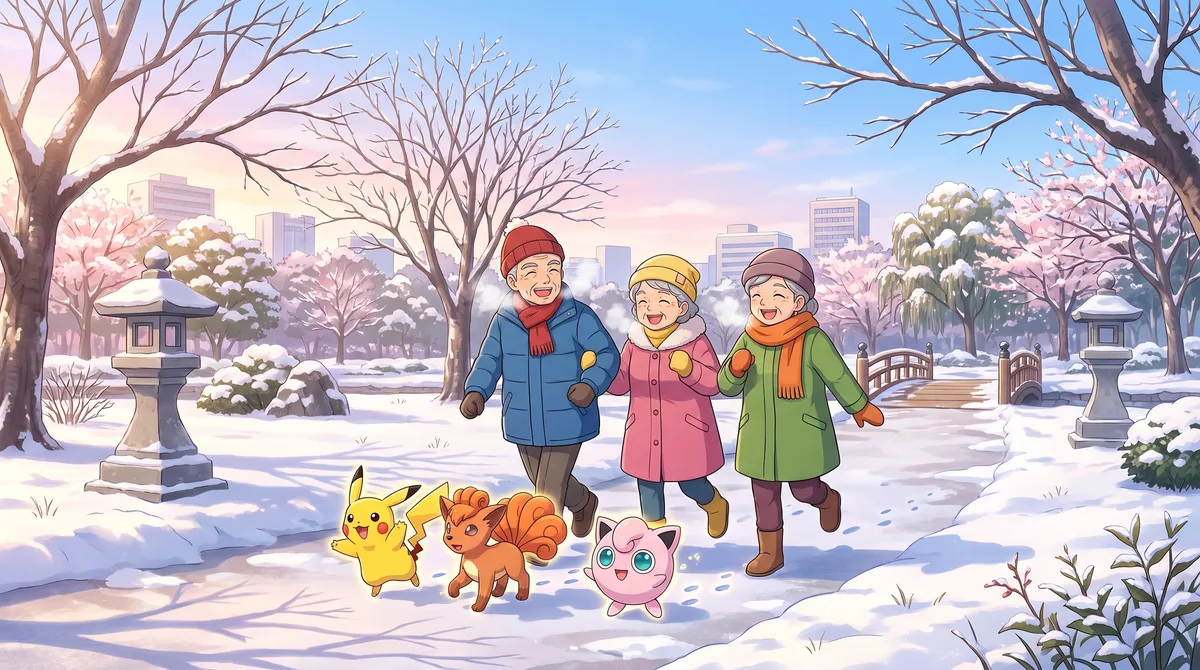
When someone plays GO and walks more, several things change at once. They engage in an activity, pursue goals and may meet other players. They also reconnect with characters that may have a place in their personal history. A result measured across this whole experience cannot divide the benefit between its different components.
- The game offers goals, progression and rewards. To examine its contribution, an activity supported by these mechanics could be compared with the same activity without a game.
- The activity performed may be walking, brushing teeth or preparing for a scan. That action needs to be measured directly: a daily login or a reward earned is not enough to show that it has changed.
- Social encounters can provide a regular meeting and a reason to return. A group walk without Pokémon would help distinguish the contribution of relationships from that of the game.
- Attachment to characters may make an invitation feel familiar, awaken a memory or create a desire to care for a companion. Isolating this contribution would require keeping the activity, support and mechanics identical, then comparing Pokémon with original characters and a version without characters.
 The game
- Goals, collecting and rewards.
 Movement
- The action actually performed and its duration.
 Social encounters
- The group's presence and regular meetings.
 Attachment
- Characters, memories and preferences.
These four dimensions form a framework for interpretation, not four independently established effects. They may reinforce each other: someone comes for Pikachu, meets people, then returns for the group. The order may also be reversed. Understanding this journey would require recording motivations at the outset and over time, including among people who stop.
Sun’s comparison illustrates the question: adding GO to step goals and support is not the same as comparing Pokémon with another franchise. Research on nostalgia documents a possible relationship between memories and the experience of playing; it does not prove that Pokémon would outperform another beloved fictional world. Randomised trial adding GO to a walking programme, Sun, 2024; Study of GO, nostalgia and well-being, Wulf and Baldwin, 2020.
The question therefore becomes: for whom does this world contribute something, at what point, and compared with what alternative? Initial enjoyment, sustained participation and the health outcome each deserve their own measure. This is the thread taken up in the research proposals.
A few milestones to place the subject in context
This timeline brings together products, studies and documented uses. It shows how connections with health have diversified; it does not describe a continuous increase in medical effectiveness. Dates refer to the launch or document indicated.
1998 · Pocket Pikachu
Nintendo historical page: the release of Pocket Pikachu
Product: walking becomes part of a relationship with a companion. Nintendo dates the Japanese release to 27 March 1998. The presentation does not measure a health benefit.2011 · Measuring steps with the Pokéwalker
Step-counting comparison, Iowa State University, 2011
Research: a university presents an accuracy comparison involving 22 children and eight adults. The date is that of the press release, not the device's launch. Counting steps and encouraging more walking remain separate questions.2016 · GO and physical activity
Follow-up of 1,182 young adults after GO's launch, 2016
Research: Howe's follow-up describes changes in steps after installation, with an initial increase that fades. The mobile game becomes a subject of behavioural research.2016 · GO in a hospital care pathway
Hospital account of getting moving again, Johns Hopkins, September 2016
Use in care: Johns Hopkins describes how a team uses the game to support walking after surgery. This is an account from practice, without a clinical comparison.2020 · Pokémon Smile and toothbrushing
Japan Dental Association announcement, June 2020
Initiative: the Japan Dental Association presents its collaboration on Smile. An everyday action becomes the subject of an app; evaluations have their own protocols and dates.2025 · Studying habits with Pokémon Sleep
Observational study of 2,063 users, Iwagami, 2025
Research: an analysis of 2,063 Sleep and Asken users follows their recorded nights. Without a control group, changes do not demonstrate a causal effect of the app.





The source library specifies how thoroughly each source was read. The catalogue provides access to the objects and initiatives. Methods, documentary limitations and updates appear at the end of the guide.